May 5th, 2021

It seems today’s technology has made every moment a camera-ready opportunity. (Just check your friends and their latest selfies.) What you may not expect is the opportunity to see a close-up of your teeth and gums in vivid detail the next time you’re in our office. But with intraoral cameras, Drs. Jay Corley and Rebecca Lauck can use the most up-to-date tools to provide your most accurate diagnosis—and let you see for yourself exactly what we’re seeing.
Intraoral cameras were developed in the 1980s. This camera makes use of a sleek wand-style design to fit easily into your mouth. Using a camera lens and its own lighting, the camera is able to show hard-to-reach places in the mouth much more clearly and easily than can be seen using dental mirrors alone. Images are projected onto a monitor or screen, where both dentist and patient can get a detailed view, and images can be enlarged, if needed, to provide better definition.
What can an intraoral camera reveal? While X-rays are invaluable for discovering treatable conditions such as cavities, infections and bone diseases, there are some conditions that are not easily apparent using X-rays alone. Small cracks in a tooth, developing cavities near crowns or older fillings, fractures, early gum disease, even areas where plaque has been missed during brushing are visible in clear detail using the intraoral camera.
How does this improve your dental care?
- We always want to use the least invasive procedure we can, and keep as much of your healthy tooth as possible. Finding small problems early prevents them from becoming large problems later.
- If you are consistently failing to brush certain teeth, or if some areas of your gums show signs of neglect, we can show you directly what places you’ve been missing so you can adjust your brushing and flossing habits.
- We can take photos if needed for your files so we have a detailed visual record of your dental status at any point in time.
- Finally, you will be able to see for yourself the reasons we might suggest certain treatments, and be better informed about your own dental health.
We’re happy to offer the intraoral camera at our Keller, TX office as one of the tools we use to provide you with the most precise and thorough care possible. Ready for your close-up?
April 28th, 2021
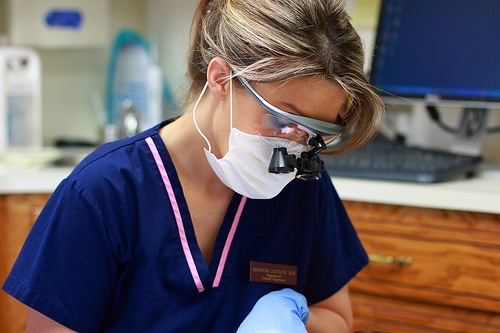
An article was released to the public stating that dental X-rays contribute to a type of brain cancer. After reading an article like this, your first thought may be to avoid dental X-rays, but you may want to hold off on that quick judgment. As with any treatment we offer at Blue Stone Dental, education is your most valuable tool in deciding what is best for you.
How often dental X-rays are taken is based on risk for infection, physical symptoms, and clinical findings. The American Dental Association (ADA) is a governing body over the dental profession. The ADA states, “ . . . healthy adults receive routine mouth X-rays every two to three years. Dental X-rays are recommended every one to two years for children and every 1.5 to three years for teens. Children often require more X-rays than adults because of their developing teeth and jaws and increased likelihood for cavities.”
A "caries risk category" often determines how often dental X-rays are taken. The most recent documented resource to determine a caries risk is Caries Management by Risk Assessment (CAMBRA). This was adopted by the ADA and is used by dental professionals giving interval recommendations for X-rays.
With knowledge of your risk for dental infection, you will be informed by Drs. Jay Corley and Rebecca Lauck of the interval at which dental X-rays should be taken. You can rest assured that the standards published by the ADA have been researched extensively and are there to protect your personal health and safety.
Dental X-rays are most commonly digital, which significantly reduces exposure. There is more radiation exposure from the sun or in an airplane than in a dental X-ray. It is common practice to use a lead apron with a thyroid collar for protection during X-ray exposure.
Having a cavity means having an active, potentially harmful infection. Diagnosing such infection with minimal exposure through digital dental X-rays at our Keller, TX office does more good than harm.
April 21st, 2021

Earth Day began in 1970 as an event to raise awareness of our environment. What began as a single day in April is now recognized around the world to bring attention and education to global environmental issues. Conserving our natural resources, reducing water and air pollution, and developing green technologies are all ways in which we can improve the environment around us.
Reduce, Recycle, and Reuse
One of the easiest ways to participate in Earth Day is by simply reducing the amount of refuse that ends up in landfills. Many communities have recycling programs for paper, plastic, and metal refuse. By keeping recyclable items out of landfills, we reduce the need for new disposal space and the amount of energy needed for burning refuse. Recycling products also helps conserve the resources that are used in making new products.
You can save money by reducing your consumption of many everyday products. Single disposable water bottles can be recycled but they are costly. By using filtered faucet water, you can conserve your financial resources. Disposable paper towels can also be wasteful. Consider reusable cleaning rags for the majority of your chores.
Reusing items saves both the environment and your finances. A large number of products can be re-purposed to create a new item. Old furniture can be remade into a new piece. Old clothing can be used for craft items. If you are not able to find ways to reuse your old items, donate them to a charity. Remember to continue your positive environmental steps on a daily basis.
Other things you can do to improve the environment
Everyone, young or old, can find ways to participate in improving the environment. Some ideas include:
- Planting trees
- Picking up litter
- Reducing energy consumption
- Walking, bicycling, or carpooling to work or school
- Disposing of hazardous waste properly
- Using rain barrels to conserve water for plants
Earth Day is designed to appreciate and celebrate the health of the earth. Keeping the earth healthy is important, but keeping your mouth healthy is important, too. Healthy teeth and gums contribute to your overall health and well-being, so remember to call our team at Blue Stone Dental to schedule an appointment. Have a happy and healthy Earth Day, from Drs. Jay Corley and Rebecca Lauck!
April 14th, 2021

Well, of course you can chew gum and wear braces. But, should you chew gum and wear braces? That can be a sticky question.
For many years, the answer was a firm “No.” Not only did our favorite chewables literally gum up the (dental) works, but they were filled with loads of the sugar that cavity-causing bacteria love to feed on. The result? A much better chance of damage to your orthodontic work, and a higher risk of cavities near your brackets and wires.
But times, and gum recipes, change. Today’s sugar-free gum provides us with some new ideas to chew over.
- Sugarless gum is much less sticky than regular gum, so it is much less likely to stick to your appliance. If there is any chance that gum will damage your wires or brackets, we’ll let you know that it’s best to wait until your braces are off to indulge.
- Some orthodontic patients find that their jaws and ligaments are less sore if they chew gum for a few minutes after an adjustment.
- Most important, studies suggest that chewing sugarless gum might actually help prevent cavities from forming. How is that possible?
Because chewing gum increases our production of saliva! Okay, we don’t normally find saliva an exciting, exclamation-point-worthy topic, but let’s look at the dental benefits:
- Saliva washes away food particles and bacteria. And because braces can trap food when we eat, it’s great to have some help washing away any meal-time souvenirs.
- Saliva helps neutralize acids in the mouth. The acids found in foods and produced by oral bacteria lead to cavities, so diluting and neutralizing their effects provide important protection for our enamel.
- Saliva helps bathe the teeth in minerals that can actually rebuild weakened enamel. Acids in the mouth attack minerals in the enamel such as the calcium and phosphate that strengthen our teeth. Fortunately, saliva provides calcium, phosphate, and fluoride that can actually help rebuild weakened enamel.
So, should you chew gum and wear braces? The real question is, should you chew gum while you’re in braces? Drs. Jay Corley and Rebecca Lauck and our team are more than happy to provide the right answer for you! Talk to us at your next visit to our Keller, TX office about the potential benefits and drawbacks of dentist-approved sugarless gum. Depending on the kind of gum you choose and the kind of orthodontic work you are having done, the answer just might surprise you.

 Website Powered by Sesame 24-7™